
Enforcement
Deterministic extraction requires architectural conventions. Enforcement ensures code follows those conventions.
The Extraction-Enforcement Cycle
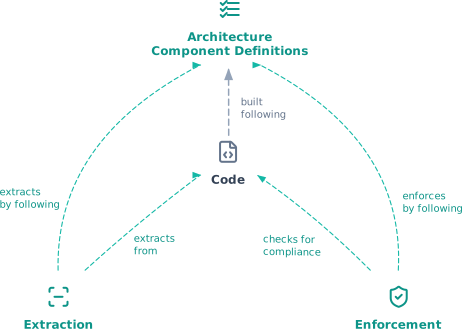
Enforcement makes extraction reliable. Extraction validates enforcement is working.
Demo Application
See enforcement in action in the ecommerce demo app:
The demo shows:
- Decorators marking components
- Extraction config detecting them
- ESLint enforcement ensuring coverage
Why Enforcement Matters
Without enforcement, extraction becomes unreliable:
- False negatives — Components missing conventions won't be detected
- Extraction drift — New code doesn't match config rules
- Silent failures — Missing components go unnoticed until architecture is incomplete
Enforcement prevents this. When all code follows conventions, extraction is reliable and complete.
Enforcement Approaches
Static Analysis (Linters)
Use linters to enforce conventions at write-time.
Advantages:
- Immediate feedback in IDE
- Catches issues before commit
- Low friction for developers
Examples:
- ESLint rules requiring decorators (TypeScript)
- ArchUnit tests for package structure (Java)
- Pylint custom checkers (Python)
TypeScript ESLint Enforcement →
Architecture Tests
Write tests that verify architectural conventions.
Advantages:
- Explicit validation
- Runs in CI
- Customizable rules
Examples:
// Verify all classes in domain/ are decorated
test('all domain classes have component decorators', () => {
  const files = glob.sync('src/domain/**/*.ts')
  const violations = findUndecoratedClasses(files)
  expect(violations).toEqual([])
})
CI Gates
Block merges when extraction fails or components are missing.
Advantages:
- Prevents drift
- Enforces at team level
- Visible in PR checks
Example workflow:
- name: Extract Architecture
  run: riviere extract --config extraction.config.yaml
- name: Validate Component Count
  run: |
    COUNT=$(riviere extract --dry-run | grep 'Total:' | awk '{print $2}')
    if [ $COUNT -lt 50 ]; then
      echo "Expected at least 50 components, found $COUNT"
      exit 1
    fi
Code Review
Include extraction validation in code review checklist.
Advantages:
- Human judgment
- Catches edge cases
- Educational for team
Checklist items:
- New API methods have
@APIEndpointdecorator - Domain logic uses
@DomainOpdecorator - Events extend
DomainEventbase class
Language-Specific Implementation
Different languages require different enforcement mechanisms:
| Language | Static Analysis | Architecture Tests | CI Gates |
|---|---|---|---|
| TypeScript | ESLint | Vitest + ts-morph | ✓ |
| Java | ArchUnit | JUnit + ArchUnit | ✓ |
| Python | Pylint | pytest + ast | ✓ |
| C# | Roslyn Analyzers | xUnit + Roslyn | ✓ |
TypeScript Example
For TypeScript, we provide an ESLint plugin that enforces component decorators.
TypeScript Enforcement Guide →
See Also
- Deterministic Extraction Overview — How deterministic extraction works
- TypeScript Enforcement — ESLint implementation